
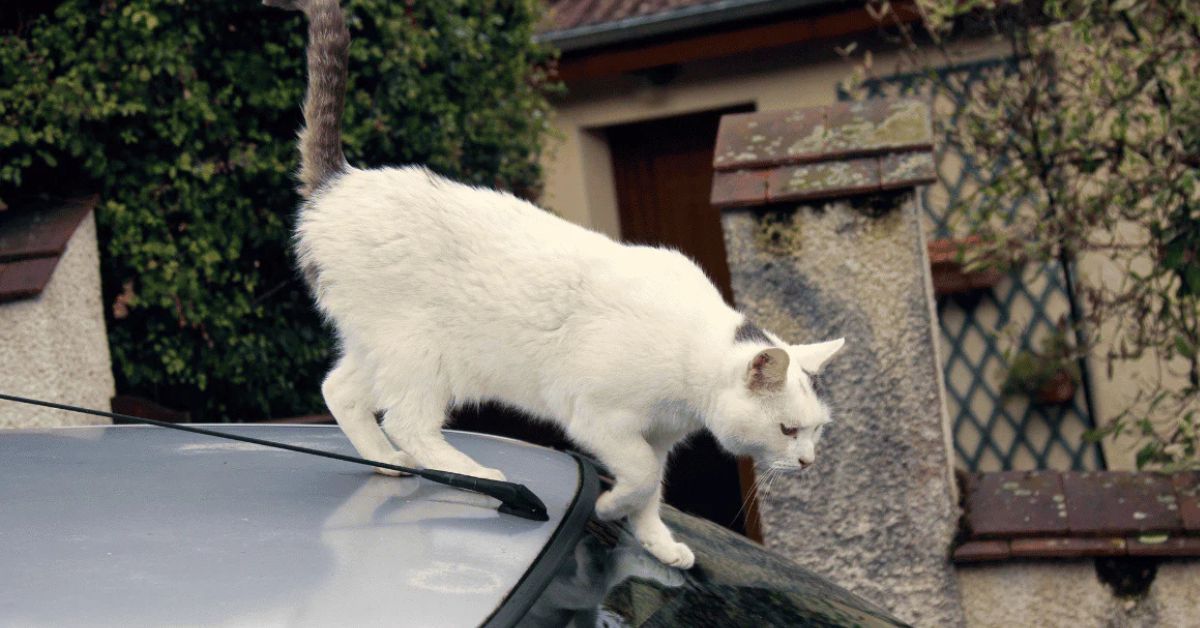
Even if you adore cats, we can almost guarantee that you don’t want them anywhere near your car. Thus, you’re here to know how to keep cats off your car.
If you find your car dented, scratched, or covered in paw prints, it can be an annoying situation for cat owners, or even for someone with neighbourhood cats wandering. Naturally, cats are inquisitive and love warm, raised surfaces, making your vehicle an irresistible spot for exploring.
Cats can leave paw prints and scratches on the body of your car. Even worse, as cats like to rest in warm locations, your pet or a stray may seek refuge within the car’s engine.
Additionally, bad things can happen if the engine is started while the cat is inside. Here is everything you need to know about how to keep cats off your automobile in order to avoid these accidents. Utilize these suggestions to safeguard your car and pet.
So, let’s dive in!
Learn more about Garage with this detailed guide.
How to keep cats off your car
- Use cat repellent spray
- Utilize mothballs
- Using Alarm sound
- Use white vinegar
- Use motion-controlled sprays
- Cover up your car while it’s parked
- Use orange leaf
Use cat repellent spray:
Sprays that repel cats are made to smell unpleasant to them. Select an organic cat repellent spray, and begin by misting the area around your car with it.
Spray the bumper, the corners of the car, and any other non-corrosive locations if the cat still decides to perch on your car. To keep the cats away, reapply the repellent every week.
A natural repellent shouldn’t damage the paint of your automobile, but it’s better to spot-test it on a hidden section of the vehicle before applying it to painted surfaces.
Utilize mothballs:
Placing mothballs in, on, and around your automobile will keep paws off of it in the easiest (and least expensive) way possible. Place the mothballs behind the tires, behind the hood, and on the roof of the vehicle.
Cats detest the smell and will take every precaution to avoid your journey. However, it’s crucial to remember that cats may be poisoned by mothballs.
If swallowed, they contain significant amounts of insect repellant and may result in digestive problems, neurological problems, or even liver damage. So always use mothballs as a last resort to get rid of car-loving cats.
However, employing mothballs is not advised because their vapors are poisonous to cats as well as humans. Mothballs should only be utilized in airtight areas, such as a garment bag, where no one will be exposed to their smells.
Using Alarm sound:
Set off your car alarm to scare away stray animals. Even the most self-assured cats will immediately move in the opposite way in response to the sudden loud noise.
However, we do not suggest honking the horns repeatedly during the day or in the middle of the night. Loud noises may irritate nearby residents.
Ultrasonic pet alarms are a fantastic alternative that is less disruptive. There is no danger of alarming the neighbors because their ultrasonic frequencies are too high-pitched for human ears to hear. These animal alarms can help keep cats and other obtrusive animals away, though.
Use white vinegar:
When they detect the smell of white vinegar, cats avoid an area. Spray white vinegar around the car in a circle to deter cats. Reapply the vinegar every few days to make sure it remains effective.
You may either use pure vinegar that is full strength, or you can dilute vinegar before using it by adding the same amount of water to the bottle as vinegar.
You may also spray vinegar directly onto your automobile if you dilute it with water. When used sparingly, white vinegar is not dangerous!
Use motion-controlled sprays:
Water splashes irritate cats. Simply attach a sprinkler to your hose, position it towards your car, and turn on the motion detector to keep cats away.
It will spray a wide arc of water whenever it notices movement to frighten the cat. Any cats around may be reluctant to approach your car once they realize they will constantly be splashed.
Remember that your car will get wet during the procedure, so roll up your windows and stay away from the sprinkler (otherwise you might get sprayed as well).
Learn more about Carburetor Cleaner with this detailed guide.
Cover up your car while it’s parked:
Your car’s paintwork can be shielded against cat claws with a cover. If you don’t mind the cat lying on your car, you don’t necessarily have to scare it away.
Instead, cover your automobile with a cover every night before you go to bed to prevent the cat from putting paw prints or scratches on it. Car covers are a safe alternative to repellent that won’t frighten or hurt the cat.
Additionally, car coverings can be somewhat pricey, but they’re worthwhile because they shield your vehicle from cats and bad weather.
Use orange leaf:
Citrus is unappealing to cats, and they will leave if they smell it. Peel a few oranges with a sharp knife. After that, spread the peels on the ground next to your car to deter cats.
The trespassing cat will probably look for a cozier spot to sit once they smell the orange. The acid in the orange can cause harm to your car’s paint, so prevent it by putting the orange peels straight on it.
Conclusion
Keeping cats off your car does not have to be difficult. When using gentle deterrents making your car unattractive to cats, and knowing a few preventive habits, you can avoid your car from messes and scratches. These methods not only keep your car safe but also make sure the cats stay unharmed, giving you peace of mind every time.
Learn more about Clean Car with this detailed guide.
FAQs
How can I stop my cat from jumping on my car?
- Make use of cat deterrent powder and spray.
- Use cayenne pepper if you can.
- Employ mothballs.
- Install a sound repellent.
- Use sprinklers with motion sensors.
- Put a car cover on.
- Trim the cat’s claws.
- Put your car in a different spot.
What smell will repel cats?
Cats don’t like the scent of citrus fruits, so use orange and lemon peels, cayenne pepper, coffee grounds, pipe tobacco, lavender oil, lemongrass oil, citronella oil, peppermint oil, eucalyptus oil, and mustard oil. ingredients.
What is the best cat repellent?
Cats are also put off by the aromas of citrus or lemon (orange peels, lemon peels), garlic, ammonia, vinegar, coffee grounds, pipe tobacco, mustard, citronella, or eucalyptus.
Reapplying is necessary because the fragrances fade with time. Sprinklers that are activated by movement: These use motion sensors to send out a brief burst of water.
How do you make homemade cat repellent?
Add two drops of each essential oil—lemon, two drops of wild orange, and two drops of lavender—to the bottle. Citrus and lavender essential oils can help deter cats because they are more sensitive to smells than people are.
What is a cat afraid of?
In the home, loud appliances might make cats nervous, especially if they weren’t exposed to them when they were kittens. Common offenders are vacuum cleaners, lawnmowers, printers, washing machines, and hair dryers.
What calms a cat in a car?
Road journeys for cats can be made less stressful by Anxiety can be reduced by using a Thundershirt®, which swaddles the cat similarly to swaddling an infant.
Preparing the carrier and easing anxiety are both possible with Feliway® pheromone wipes and spray. A relaxing pheromone collar may help to lessen anxiety.
Why are cats attracted to cars?
In the colder months, cats and kittens, especially stray ones, may look for shelter. They are frequently drawn to the warmth of freshly driven cars’ engines.
Is vinegar good to keep cats away?
To deter cats, white vinegar can be used straight up or diluted with water. If using vinegar at full strength could harm plants or items, dilute it with one or two parts water before using it as a repellent.
Will lemon juice keep cats away?
Combine the three things cats detest—lemon juice, rosemary, and white vinegar. To make the liquid simple to use throughout the garden, put it in a spray bottle. Spray on plants, the patio, or even inside, close to where the cats congregate.
Do cats hate the smell of vinegar?
Cats typically dislike the odors of citrus, vinegar, peppermint, pine, onions, and spicy foods.
Why do cats jump in front of you?
Yes, it is usual, is the short response. Cats frequently pounce on their owners as a form of play and attention. Cats that exhibit this behavior frequently hide behind a piece of furniture or a wall before suddenly leaping out at the owner.