
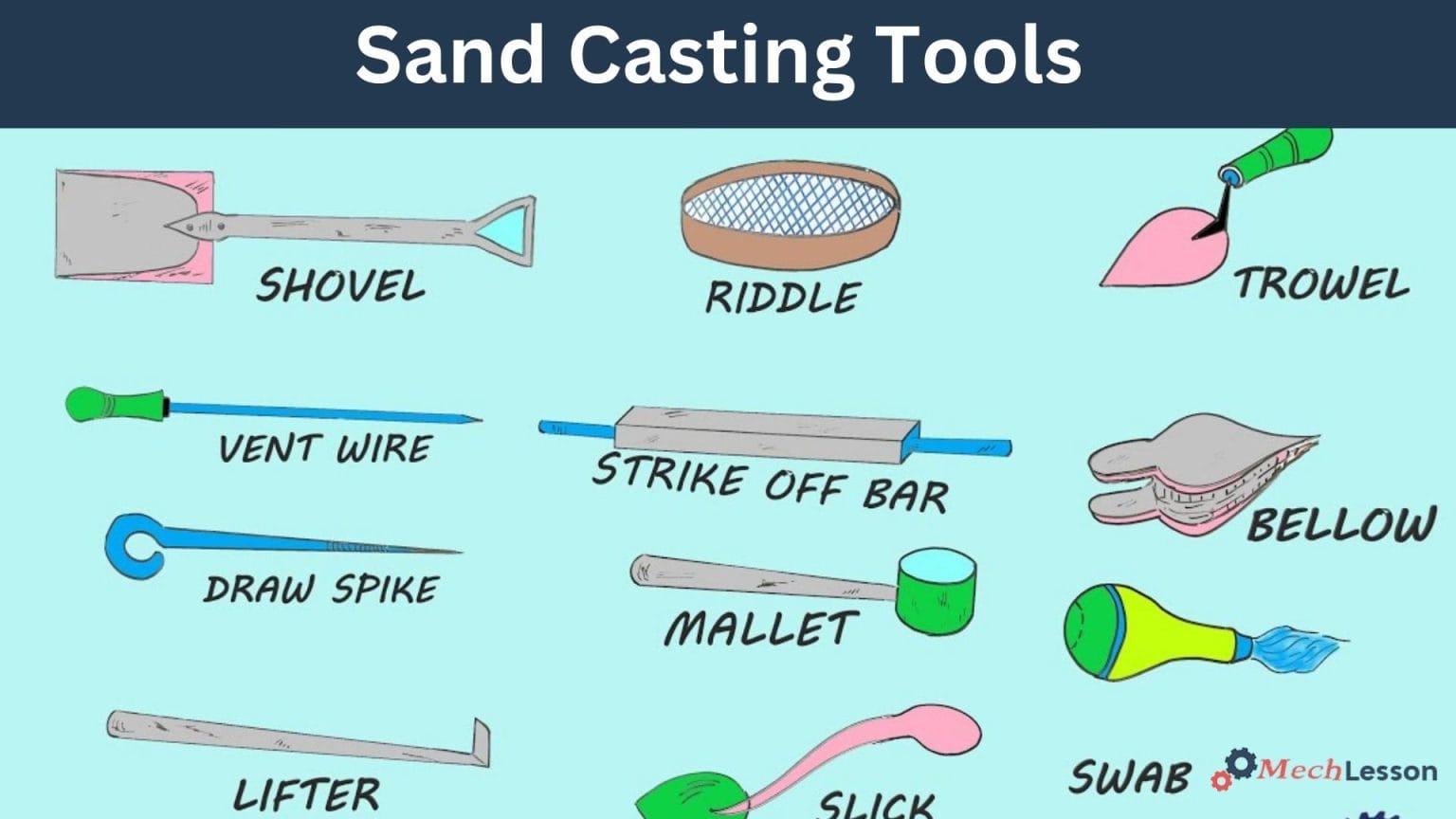
One of the oldest and most commonly used metal casting processes is sand casting. The outcome of the process depends greatly on the tools used at each production stage. The different tools used in sand casting help ensure accuracy, quality, and strength of the product, from preparing the mould to pouring the molten metal and finishing the final casting.
Each type of sand casting tool has its own function that contributes to the efficiency, reduce defect, and achieves the desired shape and surface finish. Therefore, for you to understand how simple materials and well-designed tools come together, you must understand the various types of sand casting tools and their uses.
In this reading, we’ll explore different types of sand casting tools and their uses.
Let’s get started!
Types of Casting Tools
Types of casting tools are hand riddle, shovel, rammer, sprue pin, strike bar, mallet, draw spike, vent rod, lifter, travel, slick slick, smoother, swabs, etc.
1. Hand riddle
Hand riddles are types of foundry tools generally used for cleaning sand. They are used for separating sand and other objects that serve as obstacles when molding.
Materials such as nails, splinters of wood, short metals, etc., are hand riddles consisting of a circular, wide wire mesh equipped with a circular frame.
2. Shovel
Shovels, another type of casting tool, comprise a customized sheet metal or steel pan with a wooden handle.
Shovels, another type of casting tool, comprised into the container, molding box, or flask. The purpose of these tools is to move or transfer the molding sand to the foundry sand by hand. The shovel should be maintained by keeping it clean.
3. Rammer
We use various types of rammers to repair or arrange the molding sand that loosens from the mold. These types of sand casting tools are used to pack or compact the sand uniformly around the pattern.
Types of rammer:
- Hand rammer: is generally made of wood or metal. It is portable and features a wedge-shaped end. We use it to ram the sand during bench molding work.
- Peen rammer: features wedge-shaped ends and corners. Peen rammer has a wedge-shaped construction with a metallic rod at the bottom.
- Floor rammer: floor rammer is heavy and layers when compared with hand rammer. It consists of a long steel bar with a peen at one end and a flat portion on the other. Floor rammer is used in floor molding for ramming sand for larger molds.
- Pneumatic rammer: this type of rammer is used for making large molds, just as a floor rammer. It eases work, saves time, and reduces hard labor.
Read more: What is Die Casting? its Diagram & How it Works
4. Sprue pin
sprue pin is used to produce a vertical hole in a sand casting. Wood, metal, or a tapered rod form its construction. The molding sand produces a cylindrical or conical shape as it pushes into the core to join the mold cavity.
5. Strike of bar
strike bars are sand-casting tools that are made of iron and wood. they are used to remove or strike off excess sand from the top of a molding box. It is made of a flat bar having a straight edge.
6. Mallet
Mallets are sand-casting tools used in driving the draw spike into the pattern. It’s also used for rapping to easily separate the mold from the pattern from leaving the mold cavity.
Causing it not to damage the mold surface. Generally, a mallet is used in carpentry or sheet work.
7. Draw spike
A draw spike is a tapered steel rod having a screw head on the end and a loop or ring at the end. It is used for driving into a pattern that is embedded in the molding sand and reps the pattern. To get separate from the pattern and finally draws it out from the mold cavity.
8. Vent rod
Vent rods are types of casting tools made of a round-headed wooden handle and a pointed edge. At the end is a wire made of a thin, spiked steel rod.
It is used after utilizing ramming and the striking of excess sand to produce a series of small holes in the molding sand in the cope portion.
The holes pierced allow the steam and gases produced during the pouring process and solidifying stage to escape.
9. Lifter
A lifter is also known as a cleaner or finishing tool. It’s used for cleaning, repairing, and finishing the bottom and sides of the deep and narrow openings in the mold.
The lifter is made of thin sections of steel of various lengths and widths, with one end bent.
Read more: The Four Common Types of Metal Casting
10 Travels
These types of sand casting tools are used for finishing flat surfaces and joints and parting lines of the mold.
It’s made of a metal blade made of iron and with a wooden handle. It’s also used in guts and repairs mold surfaces.
11. Slicslick
Slicslicks are types of sand casting tool that are generally used for repairing and finishing mold surfaces and their edges. It’s done after the withdrawal of the pattern.
The common types of slicks are heart and leaf, square and heart, spoon and bead, and heart spoon. Their nomenclature is largely due to their shapes.
12. Smoother
Smoother is given a different name according to their names. It is generally known as a finishing tool used for repairing and finishing flat and round surfaces, round or square corners, and edges of
13. Swabs
Swabs are small hemp fiber brushes used for moistening the edges of sand mold surfaces and patterns.
It is also used for coating the liquid blacking on the mold faces in dry sand molds.
14. Spirit level
the spirit level is used by the molder to check whether the sand bed or molding box is horizontal or not.
15. Gate cutter
A gate cutter is made of a small-shaped sheet metal commonly used for cutting runners and feeding gates for connecting spruce holes with the mold cavity.
16. Daggers
Daggers are made of pieces of wire or rods bent at one or both ends which are used for reinforcing the downward projecting sand mass in the cope.
17. Bellows
Bellows are used to blow away loose or unwanted sand from the surfaces of the mold cavity.
Read more: What is Evaporative Pattern Casting (EPC)? Diagram & How it Works
18. Clamps, cutters, and wedges
Clamps, cutters, and wedges are made of steel used for clamping the molding boxes firmly together during pouring.
Sand Casting Tools Video
Conclusion
Sand casting helps ensure that the casting process is carried out smoothly and effectively. As already mentioned, each tools serves a specific purpose that improves the quality and accuracy of the finished product. So, having a proper understanding and use of these tools help reduce errors, enhance safety and improve productivity in the foundry.